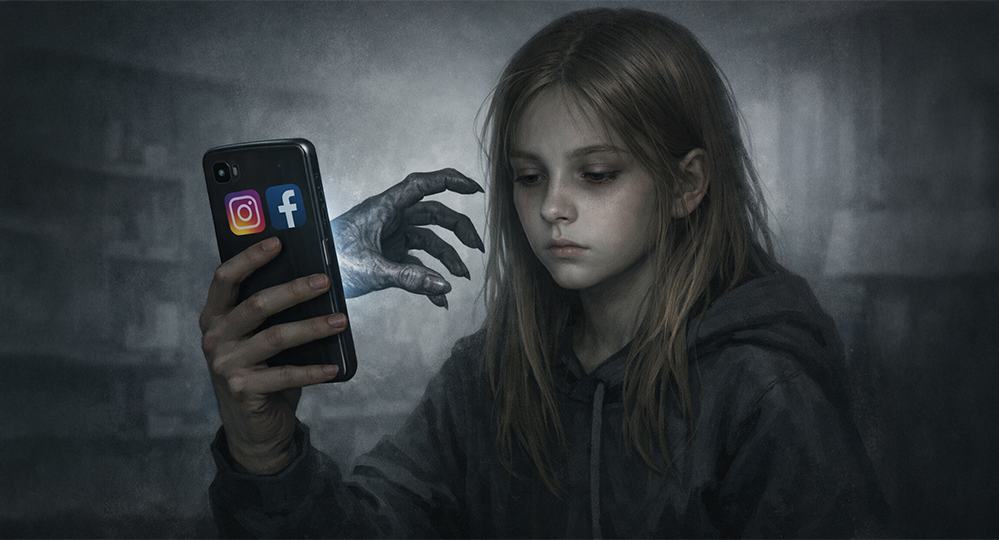

Dangerous Feed: How Social Media Is Warping Our Children’s Lives
I live in Ottawa and am raising two teenagers. And, like probably thousands of other parents, I find myself more and more often returning to the same troubling thought: my children are no longer living beside me, but somewhere inside a screen. The moment school is over, their hands automatically reach for their phones. The feed, reels, messages, endless videos, чужие faces, other people’s opinions, other people’s advertising. And yet I so want them, after classes, to go outside, breathe fresh air, read, argue, laugh, and build real friendships — not friendships through a screen.
When we were children, there were no social networks. We spent our days outside until evening, played team games, learned how to communicate, reconcile, and be friends. We read books, talked with our parents, listened to our grandparents, absorbed their experience, their memories, their wisdom. Today, all of this is increasingly being replaced by algorithms, artificial intelligence, and intrusive reels that do not build character, but far too often turn children into convenient, thoughtless consumers — exactly the kind that major platforms profit from through enormous advertising revenues.
And this is not just a mother’s emotion. On March 24, a jury in New Mexico ordered Meta to pay $375 million, finding that the company violated consumer protection law and misled users about the safety of Facebook, Instagram, and WhatsApp. Meta has already said it disagrees with the verdict and will appeal it. Meta also says it is strengthening protections: Teen Accounts on Instagram, and later on Facebook and Messenger, were given default privacy settings, message restrictions, and stricter parental controls.
But even after these steps, Reuters reported that researchers had raised concerns about the effectiveness of some of these protective features. In Canada, the issue is especially sensitive because Cybertip.ca has long identified Instagram as one of the main platforms through which teenagers are drawn into sextortion schemes.
Yet even without this court case, parental concern is entirely justified. Statistics Canada notes that young people aged 15 to 24 use social media and messaging platforms more than anyone else, and Canadian data links heavy use of social platforms with sleep disruption, cybervictimization, and worsening mental health among teens. Mental Health Research Canada also reports that higher screen time among young people is associated with more frequent anxiety, depression, and suicidal thoughts. The Canadian Paediatric Society states clearly that responsibility cannot rest on families alone — platforms and governments also have a duty to protect children.
It is especially painful to think about this here, in our beautiful, peaceful Ottawa. In winter we have snow, open space, light, skating on the Rideau Canal, skiing and tubing, trips to Mont Cascades. Our children could be spending their time on the ice, on the slopes, in motion, in real laughter, in real life. But too often they choose the phone — or rather, the phone chooses them.
That is why I think more and more often that Canada needs stricter rules. Not symbolic warnings, but real measures — default privacy for minors, stricter age verification, algorithm transparency, and serious penalties for platforms if they fail to protect children. Ottawa is once again returning to the discussion of online safety, and this conversation must not be postponed again. Because this is not about technology. It is about children.
Author: Itina N.