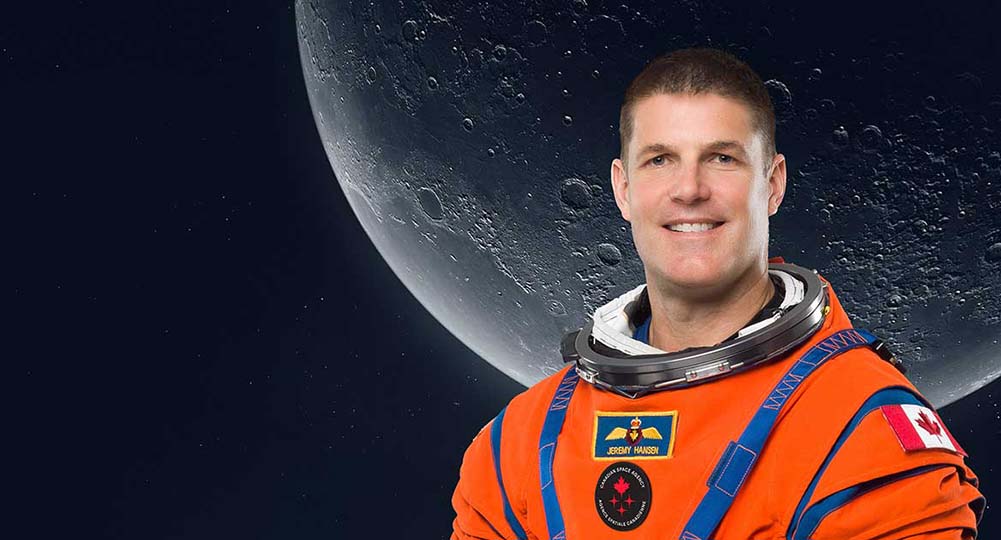

Space Without Borders: How Canada Found Itself at the Heart of NASA’s Lunar Program
When I watched the images of Earth disappearing beyond the lunar horizon, I felt an almost childlike sense of awe. But even stronger was the feeling of pride. Among those who embarked on this historic journey was one of our own — Canadian astronaut Jeremy Hansen. Perhaps our parents felt the same pride and joy when they first learned about Yuri Gagarin’s flight into space.
The Artemis II mission is already being called one of humanity’s most important steps in space exploration in recent decades. For the first time since the Apollo era, humans have traveled so far from Earth — toward the Moon. For Canada, this moment carries special significance. For the first time in history, a Canadian is part of a crew flying around the Moon.
The crew includes experienced NASA astronauts: commander Reid Wiseman, pilot Victor Glover, mission specialist Christina Koch, and mission specialist Jeremy Hansen. His presence makes this mission truly international.
At first glance, it may seem surprising that an American program — strongly promoted since the administration of Donald Trump — includes a foreign astronaut. But a deeper look reveals a clear explanation. Canada has been a key partner of NASA for decades, especially in space robotics.
One only needs to recall the legendary Canadarm robotic systems, essential to both the Space Shuttle era and the International Space Station. Today, Canada is taking the next step by developing Canadarm3 for the future Gateway lunar station. In return for this contribution, the country secured a seat on a lunar mission.
And here, the story takes on an almost dramatic tone. When Hansen was selected as an astronaut back in 2009, the outlook was uncertain. The shuttle era was ending, new spacecraft had yet to emerge, and private companies like SpaceX were only just beginning. Hansen himself admitted that he might never fly to space in his entire career.
Today, it is hard to believe how much has changed. SpaceX has become a major player, NASA has returned to the idea of lunar exploration, and Canada — unexpectedly for many — has found itself at the center of these developments.
Yet Artemis II is only the beginning. In the coming years, NASA plans not just to return humans to the Moon, but to establish a permanent presence — with bases, infrastructure, and international collaboration. This is no longer symbolic; it marks the dawn of a new space era.
There is also a hint of irony: the Gateway station project, into which Canada has invested billions, may be reconsidered in favor of a lunar surface base. But regardless of shifting plans, the participation of a Canadian astronaut is already a historic achievement.
Perhaps the most important conclusion for me is this: space has no borders. Despite political disagreements, bold statements, and economic tensions, nations continue to cooperate where the future of humanity is at stake.
And for us in Canada, it is also a moment of genuine pride. Because as the spacecraft circled the Moon, among the American astronauts was one of our own — a Canadian — and that will forever remain part of history.
Author: Dmitry V.