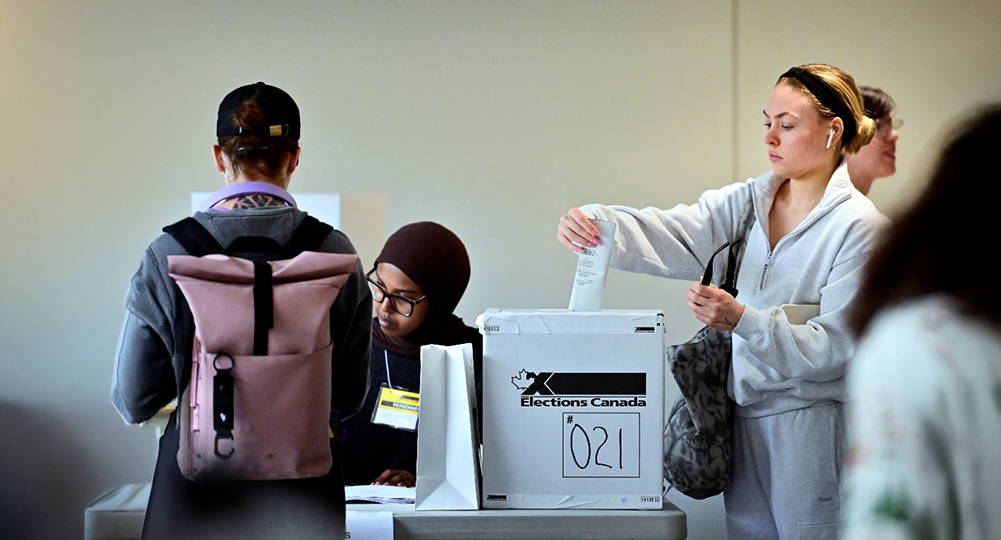

How Elections Work in Canada
Canadian voters have a say at three levels of government. The federal Parliament deals with immigration, defence, foreign policy, and federal taxation. Provinces are responsible for healthcare and education. Municipalities oversee what you see outside your window: roads, public transit, snow removal, parks, libraries, and urban planning. The voting principle is similar at every level, but what is at stake differs.
Federal level: you elect an MP, not the Prime Minister
In federal elections, Canadians do not vote directly for the Prime Minister. Instead, they vote for a candidate in their electoral district. Canada is divided into 343 electoral districts, each of which sends one Member of Parliament, or MP, to the House of Commons.
The candidate who receives more votes than any other candidate wins—even if that amounts to only 35 percent of the vote. This system is called first-past-the-post. The party that wins the most seats usually forms the government, and its leader becomes Prime Minister. If the party holds more than half of the seats, it forms a majority government. If it has fewer than half, it forms a minority government and must negotiate with other parties on every major decision.
Federal elections are administered by the independent agency Elections Canada. Voters may cast their ballots on election day, during advance voting, or by special ballot through the mail. The law establishes a fixed election cycle, but an election may be held earlier—for example, following the dissolution of Parliament.
Provincial elections: Ontario and Quebec
Ontario uses the same basic system. The province is divided into 124 electoral districts, each electing one Member of Provincial Parliament, or MPP, to the Legislative Assembly. Elections Ontario administers the process.
In Quebec, elected representatives are called Members of the National Assembly, or MNAs, and sit in the National Assembly. By the next election, the number of electoral districts will increase from 125 to 127. Voting is scheduled for October 5, 2026. Under Quebec law, general elections are held every four years on the first Monday in October. The process is administered by Élections Québec.
The practical implication for our region is simple: a Gatineau resident votes for a representative in Quebec’s National Assembly, while an Ottawa resident votes for an MPP in Ontario. In both cases, voters elect their local representative—not the head of government.
Ottawa votes on October 26
Municipal elections have the most direct impact on everyday life. On October 26, 2026, Ottawa residents will elect the mayor, their ward councillor, and a school board trustee. One important difference is that candidates on Ontario municipal ballots do not run under party banners: voters assess the individual, not a party logo.
Ottawa has 24 wards. The mayor represents the entire city, while each councillor represents a particular ward. Special advance voting will take place from October 1 to 4, and the regular advance voting day will be October 16. On election day, most polling stations will be open from 10:00 a.m. to 8:00 p.m.
To vote, a person must be a Canadian citizen who is at least 18 years old and either lives in Ottawa, owns or rents property in the city, or is the spouse of such an owner or tenant. Your name must appear on the voters’ list, so check your registration in advance rather than waiting until you arrive at the polling station.
How do you get your name on the ballot?
Municipal politics is open to more than just career politicians. To run for city council, a candidate must submit the required form and identification to the Elections Office, collect at least 25 signatures from eligible voters, and pay a $100 nomination fee. Campaign finances are regulated by law and are subject to reporting requirements.
In 2026, nomination papers are accepted from May 1 until 2:00 p.m. on August 21. On August 24, the City certifies the nominations.
Where to find candidates’ platforms—and how to get involved
The City’s website confirms candidate registrations and provides their contact information, but it does not publish their platforms. Candidates present their priorities on campaign websites, during door-to-door canvassing, at debates, on social media, and in responses to community questionnaires. The level of detail varies from one candidate to another—another reason to follow campaign updates until election day.
There are two ways to help. Volunteers can join campaign teams, distribute materials, call voters, and assist at events. Those interested in how elections operate behind the scenes can also apply for paid work. The City of Ottawa is recruiting more than 5,000 election workers for October 16 and 26. Mandatory training is provided, knowledge of both English and French is an asset, and applicants must be at least 16 years old when they begin working.
Canadian democracy does not begin with a check mark on a ballot. It begins with a question for the candidate: What exactly will you do for our neighbourhood—and how will we be able to verify the results?
If you would like to volunteer in the upcoming elections, please contact me.
Author: Katerina Belinson
fb.com/belinson.ekaterina