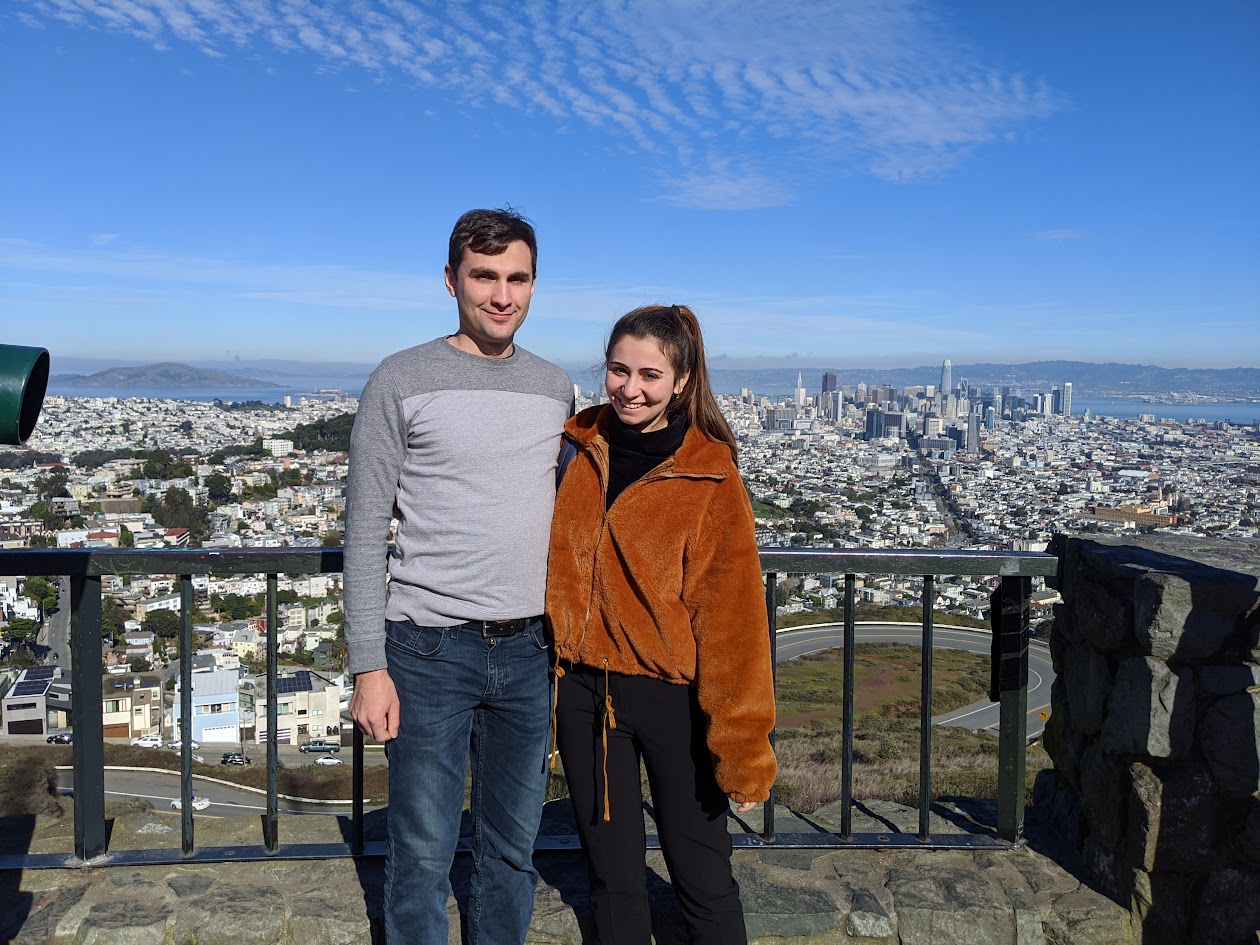

Physicists and Lyricists
Author: Marina Kochetova
I believe the time will come —
When the power of meanness and evil
Will be overcome by the spirit of good.
(B. L. Pasternak)
Many people believe that good days bring happiness, bad days give experience, the worst days teach us lessons, and the best days stay in our memory forever. The same can be said about people. The people I am about to tell you about, I hope, will be remembered by readers. They are Lyonya and Olya Koppel — brother and sister.
They were born just over nine months apart in the mid-1990s in St. Petersburg, where they spent the first years of their lives. Their personal development, however, took place in Ottawa. Their father, Alexander Evgenievich, a highly educated man, received an interesting job offer in Canada, and the family moved to Ottawa. Olya and Lyonya were still preschoolers at the time.
At first, the family lived near the Museum of Science, and regular visits there became part of their daily routine. From the moment they arrived in the Land of the Maple Leaf, both the children and their parents liked everything: the kindergarten with its friendly educators, the school with kind teachers, neighbours from all over the world with fascinating traditions and interests, the beautiful nature, and even Ottawa’s unusually cold winters. They liked it not because they had never been beyond their native harbour before — after all, they had not come to Canada from some provincial backwater, but from one of the most beautiful cities in the world. Rather, it was as if they were wearing rose-coloured glasses. In truth, people woven from the fibres of kindness, people who treat everyone and everything with kindness, carry goodness within themselves — and therefore notice goodness around them.
The brother and sister eagerly and joyfully began attending all kinds of extracurricular activities. Olya did gymnastics, taekwondo, and dance, and sang in an English-language choir. Lyonya took swimming lessons and learned to play percussion instruments. Both played soccer and tennis. Later, they studied drawing together with a professional Russian-speaking artist. In addition to visual arts, Olya decided to learn the piano, and later the flute. Sometimes, while preparing for music lessons, she would be upstairs playing the flute, while he would be downstairs practising the drums. In the school orchestra, the sister played the flute and the brother played percussion. Lyonya had a habit of reading newspapers at breakfast. Olya, sitting across from him, learned to read text upside down.
In winter, together with their parents, they went skating on the canal and did not forget about downhill skiing, so popular in Canada. In summer, the whole family would ride bicycles, covering up to forty kilometres at a time. They always stopped to admire nature, paying attention to its beauty and diversity. In short, like many others, their life was active and full. They grew up close, spending a great deal of time doing things together. For both of them, the scent of childhood remains very pleasant to this day.
From childhood, Olya showed a clear inclination toward the humanities. From Grade 1, she regularly kept a diary. Her favourite subject at school was English. She did not like chemistry, and she never even took physics as a school subject. In her teenage years, her organizational abilities became especially evident and later developed further during her university years, when she organized a flute ensemble that eventually grew into an orchestra of seventy musicians.
However, she did not enter a humanities faculty at university, choosing instead to specialize in biology. She was interested in botany and zoology. Her natural curiosity and love of nature, present since childhood, prevailed when it came time to choose a profession. Once she entered a biochemistry laboratory at the University of Ottawa, Olya became fascinated by the process and met real scientists who inspired her to pursue research in this field. In her fourth year, she had to conduct an independent study on the topic of how weeds affect the first spring flowers. In the fall, the young researcher collected plant seeds with her own hands, and they were sent to spend the winter in a refrigerator. In spring, they were to be planted in a designated greenhouse and closely observed as they grew and developed. Olya became deeply engaged in this experiment, even though it took a great deal of time — and in addition to her studies, she was working and managing the orchestra. Once, in between all of this, she and a friend won a business competition.
Her older brother Lyonya studied in a gifted children’s program from Grade 5 until the end of high school. In Grade 12, he served as a director in the school theatre. It was a production of Othello, which he first directed, then filmed, edited, submitted to a competition in Stratford — and unexpectedly became one of the winners. Throughout his school years, he did very well in all subjects. Unlike his sociable sister, quiet Lyonya preferred filming with a camera to talking. From the age of eleven, he was already a programmer; he loved it from childhood and found it easy. While in high school, at the request of the school principal, he independently created the school website. He was easily admitted to the engineering faculty at university in Kingston, following in his father’s footsteps, specializing in engineering physics. Before he had even properly become a student, he won a competition for the best university uniform design. During vacations, he worked as a programmer and refereed soccer matches.
Living with friends, he often took his turn in the kitchen, and his friends looked forward to his cooking days because Lyonya made delicious soups for everyone — a skill he had learned from his mother in childhood. Olya, meanwhile, learned to sew well from their mother. After receiving his bachelor’s degree, Lyonya used his savings to travel the world for an entire year: he lived in New Zealand, Australia, and Europe. Upon returning, he entered a master’s program, though in a somewhat different field and not in Kingston, but in Waterloo. He worked in robotics, computer vision, and automated vision in an autonomous vehicle laboratory. As part of his master’s studies, he invented a self-driving car. This invention had been preceded by another creation during his studies in Kingston — a “lunar robot.” Despite being away from Ottawa for a long time, he never became detached from his family, and his close relationships with his sister and parents remained intact.
His younger sister Olya had not been thinking about a master’s degree until she accidentally came across an interesting announcement. What caught her attention was the opportunity to study and travel at the same time. After submitting the required documents and receiving acceptance into the master’s program, Olya went to the small town of Swansea in Wales, where she earned a master’s degree in her field at the local university. During her studies in Wales, she visited Paris, Geneva, Edinburgh, Glasgow — in short, she saw the world. Returning to Ottawa, she entered graduate studies at her home university. Her research topic was connected with DNA. Olya conducted experiments with bees and bumblebees; in Wales, the subjects of similar experiments had been algae. The graduate student studied the impact of environmental changes on bumblebees, spending a great deal of time at the computer processing the results of her experiments, summarizing them, and comparing them with similar research conducted by colleagues. Today, her dissertation has been successfully defended, and Olga now works as an ecologist at the Canadian Wildlife Foundation.
Olya’s remarkable brother wrote and defended a dissertation titled Manifold Geometry for Robotics in C++. He has been living and working successfully in California for several years. He is a programmer responsible for software for self-driving cars at a company specializing in automotive technology.
These are two parallel success stories of young people with old-fashioned values. Olya and Lyonya share an enviable combination: in each of them, physics and lyricism exist side by side. Both have a strong attraction to science and art: the sister remains devoted to lyrical music and poetry, while the brother is passionate about painting and cinema. At the same time, despite their young age as scientists, they have already reached certain heights in science.
Yet their greatest achievement is their ability to see only the good in people. From early childhood, these two were taught to treat the world with kindness, and much of the credit for this belongs to Dasha, their charming mother. Childhood impressions are very important. That is why we must hurry to fill a child’s heart and mind with light and goodness from the earliest years; parents need to try to spend more time with their children — and to do so meaningfully. Over time, what was absorbed in childhood may once again cleanse and save a person from the uncertainty of today. After all, in difficult times, each of us can light our own small candle in the darkness of the universe and become a ray of light.