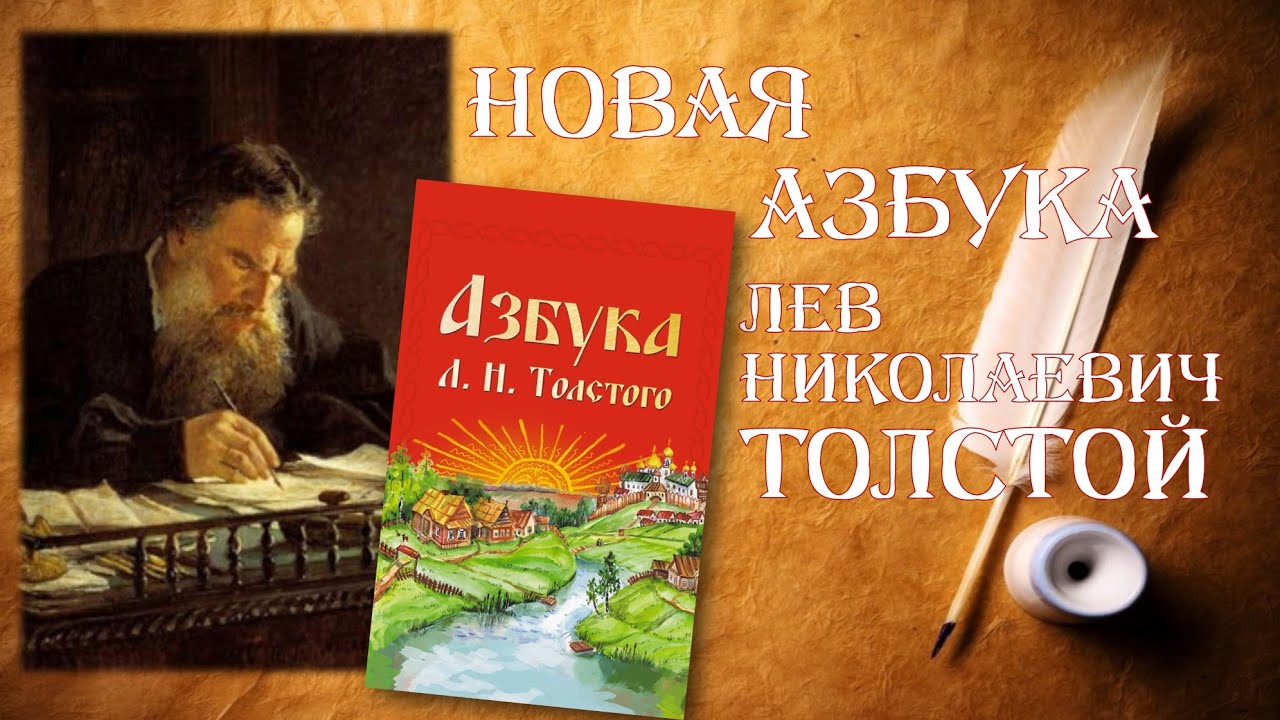

Leo Tolstoy’s Marvelous ABC Book
Author: Marina Kochetova
A new school year is about to begin, bringing an increased workload for teachers, students, and parents alike. Why not turn to the classics for help?
Did you know that Leo Tolstoy, one of the greatest humanist writers in history, whose name is known throughout the world, wrote textbooks between War and Peace and Anna Karenina? He devoted more than fifteen years of painstaking work to creating his ABC Book and New ABC Book!
During his lifetime, Leo Tolstoy opened a school for poor children at Yasnaya Polyana, near Tula, where he taught personally. Tolstoy’s ABC Book contains many stories invented by the schoolchildren themselves. However, Leo Nikolayevich wrote most of the stories for this unique textbook. He also included his own translations of tales from Ancient Greek, Arabic, German, French, and English. The original editions of these stories are still preserved in the library of Tolstoy’s house museum at Yasnaya Polyana.
In his beautifully illustrated texts, Tolstoy deliberately avoids formal grammatical explanations, giving young readers an opportunity to engage thoughtfully with what they read and develop their intellectual curiosity. Tolstoy skilfully conceals grammatical material within connected texts; by analysing them, students can discover some of the most important principles of the Russian language.
But what about children who have not yet learned to read? The first section of the book introduces letters and teaches reading through syllable tables. The wise teacher firmly believed that reading without understanding was impossible. Therefore, each lesson in his textbook begins by introducing a new group of words, specially selected according to similarities in their spelling. Throughout the book, Tolstoy also provides guidance for parents without professional teaching experience. Thus, even in Tolstoy’s time, it was understood that teaching a child a language should be entrusted not merely to someone who can speak it, but to a qualified professional—a teacher and linguist familiar with appropriate teaching methods.
Many decades have passed since Tolstoy created his ABC Book. During that time, both life itself and the Russian language have changed beyond recognition. Countless reading textbooks have appeared, and a great many experts continue to improve language-learning materials in response to the demands of the times. Today, the ABC books by V. Goretsky, O. Dzhezheley, E. Khamrayeva, V. Stepanov, O. Uzorova, and other respected authors enjoy great popularity.
Nevertheless, the unique textbook created by a classic of world literature remains relevant in the twenty-first century. Tolstoy’s ABC Book is a treasury of pure, vivid, expressive, and dynamic folk language. Is it not wonderful to learn to read from a beautifully written book created by a literary genius of global stature? Experience shows that those who learn the basics of reading with Tolstoy’s textbook later do more than simply read Russian: they can read classical literature with ease and genuine enjoyment.
One cannot help agreeing with I. Trukhachyova, the editor of a revised edition, who wrote: “The method proposed by Tolstoy has stood the test of time. Tolstoy’s principal secret was to turn learning to read into a pleasure. For us, modern people who have long since moved away not only from folk language but even from simple, good literary language, Tolstoy’s ABC Book is a gift from the nineteenth century.”
Today, unlike in the past, people are encouraged to develop and cultivate their own points of view. In earlier times, it was considered important for everyone to interpret prescribed literary works in the same way. There is a widespread belief that the problems described in classical Russian literature have lost their relevance for today’s generation of readers. Humanity’s outlook has certainly changed, and we no longer perceive life in the same way as people did in Tolstoy’s time. Nevertheless, how can we live and build the future without knowing and understanding the past? Tolstoy’s ABC Book can therefore become an invaluable aid.