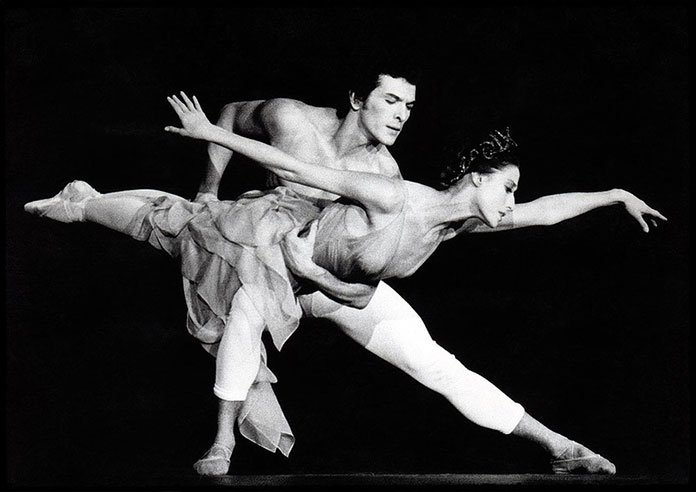

On Maya Plisetskaya's 100th birthday
author: Marina Kochetova
So much has been said, written, and filmed about Maya Mikhailovna Plisetskaya that it seems nothing more could be added. She is, without question, a genius — and the manifestations of genius sometimes unsettle us. Their free spirit surprises with unexpected insights. This unique ballerina, despite endless hardships, lived her entire life with grace and her head held high, achieving her goals against all odds. Ballet scholars say that if Plisetskaya had not appeared, she would have had to be invented: after Galina Ulanova, ballet had reached a dead end and began fading as an art form. It was Plisetskaya who broke free from conventions, remaining herself without losing her extraordinary individuality. Although she believed the greatest event of her life was her happy marriage rather than her dazzling career, she has always been — and remains — regarded as the greatest ballerina of modern times. The world’s ballet stars speak of her only in superlatives.
The world of ballet enchanted me when I was five, when my mother took me to the Bolshoi to see “Swan Lake” with Plisetskaya and Godunov. The Prince impressed me most that day, but I remembered Plisetskaya’s name forever. I never saw her on stage again. Who could have imagined that many years later I would see Maya Mikhailovna not FROM the audience, but IN the audience — right beside me?
As a friend of the Mariinsky Ballet, I often visited St. Petersburg for classes, rehearsals, and performances of that world-famous troupe. One day, in 2014, I had the extraordinary fortune to watch “The Little Humpbacked Horse” from the Imperial Box — alongside the living legend herself!
My friends were performing, so I knew I wouldn’t be sitting in the stalls but in the main box. But sitting next to Plisetskaya — I never even dreamed of it. Yet her presence made sense: she was the first performer of the Tsar-Maiden role in the ballet composed as a birthday gift for her by her husband, Rodion Shchedrin.
I took my seat early. And suddenly — a minute before the overture — Plisetskaya herself entered! For two hours, I sat one meter away from her. It was a miracle. This happened in the summer of 2014; she would turn 89 that November. Sadly, she did not live to see her 90th birthday…
How do you imagine an 88-year-old aristocrat? To my amazement, despite being 167 cm tall, she seemed tiny — like Thumbelina! In a strict black suit, hair neatly pulled back, almost no makeup, she did not resemble the vibrant, emotional woman who had defied fate all her life. Instead, she radiated softness and serenity. After a polite greeting, she sat modestly and instantly immersed herself in the performance. I hardly dared breathe, watching her reactions out of the corner of my eye. She was clearly pleased, applauding wholeheartedly for Ulyana Lopatkina, the Tsar-Maiden.
I felt overwhelmed. I couldn’t believe my eyes. How could this miniature woman be the one worshipped and adored across the world for decades? Success does not guarantee the future — but there are figures of cosmic scale whose triumph is absolute and indivisible.
The most astonishing moment awaited after the performance. When the dancers came out for their bows, the hall erupted in applause. At one point, Valery Gergiev gestured toward the Imperial Box. The audience turned — and seeing Plisetskaya standing and applauding the Mariinsky soloists, began chanting wildly: Maya! Maya! Bravo! All applause now belonged to her — and continued for twenty minutes. The acknowledged symbol of femininity graced the overflowing hall with her signature bows.
It was unbelievable. Being so close, I even felt as if the applause were meant for me! The emotional whirlwind carried me for months afterward, filling me with such extraordinary energy that I soared like a butterfly, seeing beauty everywhere.